quEDU - a Science Kit for Quantum Physics: spin manipulation of NV centers, entangled photon pairs and much more.
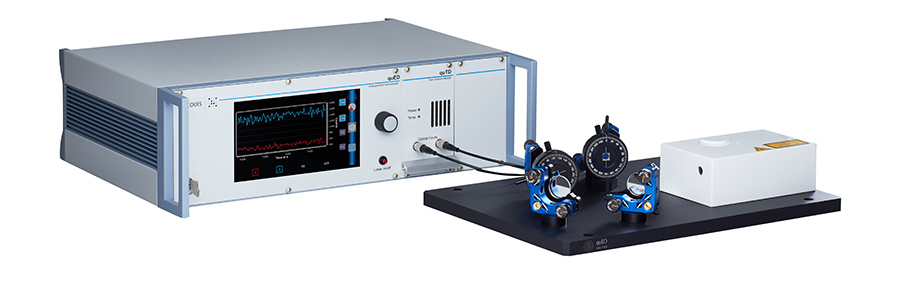
quEDU in combination with the nitrogen vacancy center experiment board.
The user interface of quEDU is the touch display and the two heavy wheels for smooth manipulation of the actors.
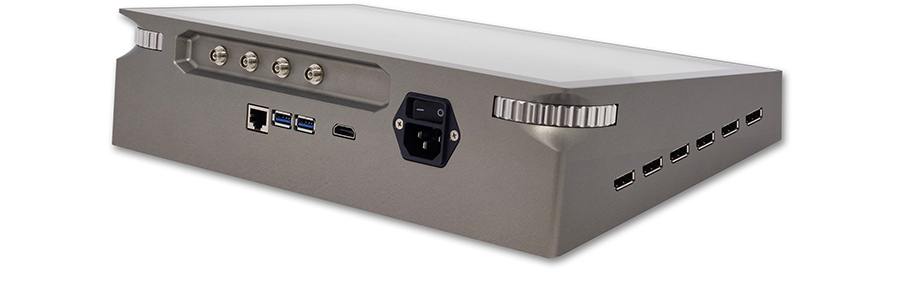
6 ports for experiment boards and 4 temperature controlled APDs with fiber port. Here with the NV board.
The touch display and the two wheels control the whole experiment, remote access is possible by Ethernet and USB next to the fiber inputs on the rear side.
Overview
Key Features
Experiment Boards
Sample Experiments
Videos
Downloads & Links
The quEDU is the control unit for all connected experiments and measure their photon output. A NV experiment board is connected to the quEDU to study the properties of nitrogen vacancy centers in diamond.
The quEDU is a platform for various quantum physics experiments. It contains single photon detectors and time tagging electronics for data acquisition and analysis as well as digital interfaces to control the experiments.
The quEDU and its experiment boards combine the latest achievements in quantum optics technology into an easy-to-use system for academic, research and applied purposes with high precision. Advanced models for scientific purposes are also available, with high performance to meet the requirements of state-of-the-art physics experiments.
The qutools Quantum Education kit is designed with educators in mind. It’s the easiest and most reliable way to explain the complex phenomena of quantum mechanics by generating and analyzing polarization-entangled photon pairs or manipulating electron spins in a diamond.
Key Features
Hands-on study of quantum entanglement
Photon entanglement and spin manipulation
High modularity for different experiments
User-friendly operation, complete system
Add-ons to extend experiments
Specific Applications
Student lab course experiments
Violate Bell’s inequalities
Heralded single photon source
NV center spin manipulation
Optically detected magnetic resonance
Control and Usage
Touchscreen & rotary buttons
6 ports for experiment boards
Pattern generator and pulse streamer
Remote desktop via WLAN, Ethernet
Detection and Analysis
4 temperature controlled APDs with fiber port
Time tagging electronics with picosecond jitter
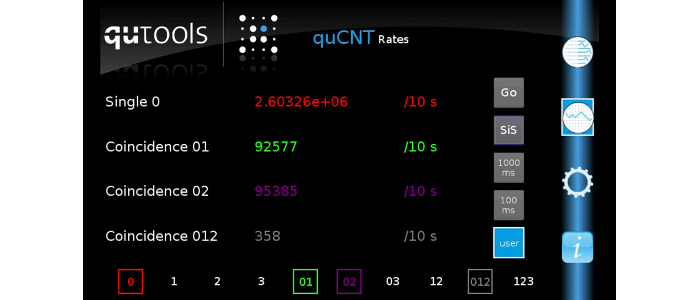
Singles & coincidence events counting
Analysis and processing of measurement data
Experiment Boards
The quEDU can be connected to various photon sources or experimental boards with optical setups like a Michelson Interferometer or a NV center.
+ NV Nitrogen Vacancy Centers
Quantum Sensing Education by NV-Centers
quEDU in combination with the nitrogen vacancy center experiment board.
A ODMR (optically detected magnetic resonance) scan of the microwave frequency.
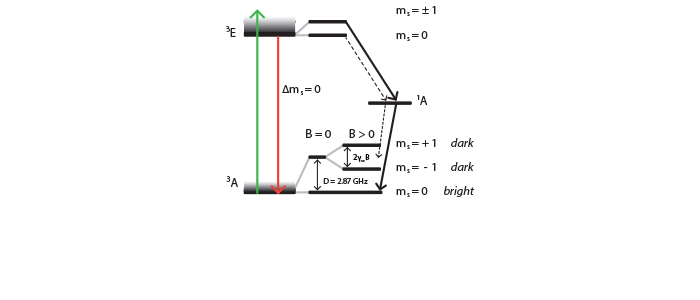
The NV experiment board allows you to experience the properties of nitrogen vacancy centers in diamond, such as NV center fluorescence, electron spin manipulation, optically detected magnetic resonance, and basic qubit operations.
The device comes in a compact design suited for a lab table or lecture hall with the optics enclosed and the electronics in the base of the device. The NV centers in the diamond and all optics are encapsulated by acrylic glass to ensure laser safety.
At the heart of the NV is a green laser focused on the nitrogen-doped diamond through a microscope objective. The diamond begins to fluoresce in the red wavelength range. This light is collected by the objective and, after some filtering, is coupled into a fiber. The fiber is connected to the quEDU and the fluorescence can be analyzed.
The sample itself contains three diamonds and can be aligned by linear stages. It also is in close proximity to a microwave antenna and is surrounded by coils producing a homogeneous magnetic field. That field can be manipulated in all dimensions.
In addition, the quEDUs included pattern generator is precisely controlling pulse sequences for laser, microwave, and readout, enabling a multitude of spin-control experiments.
The ED design combines recent achievements of quantum optics technology into an easy-to-use system for academic, research and applied purposes with precise accuracy. Advanced models for scientific purposes are available as well, with a high performance meeting the requirements of state-of-the-art physics experiments. See how the SPDC source works.
+ ED-MI Michelson Interferometer
Demonstrate the wave nature of single photons through their interference or build a quantum eraser.
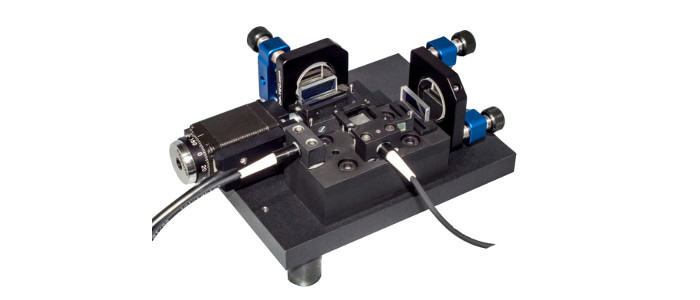
Single Photon Michelson Interferometer Add-On for the quED.
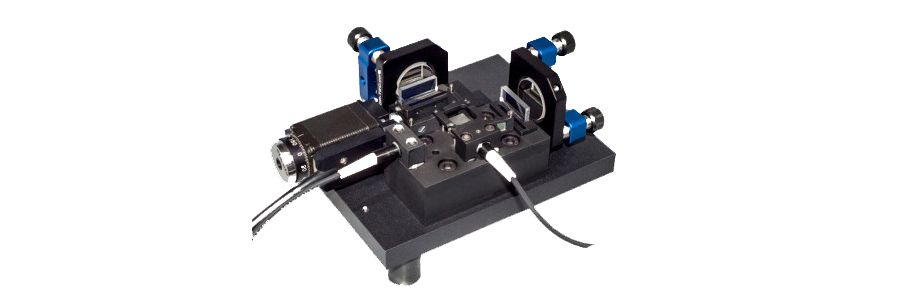
Single Photon Michelson Interferometer Add-On for the quED.
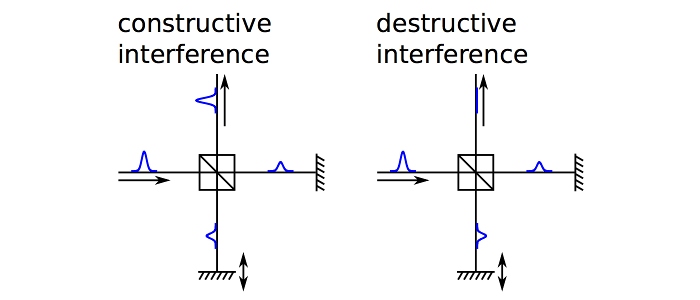
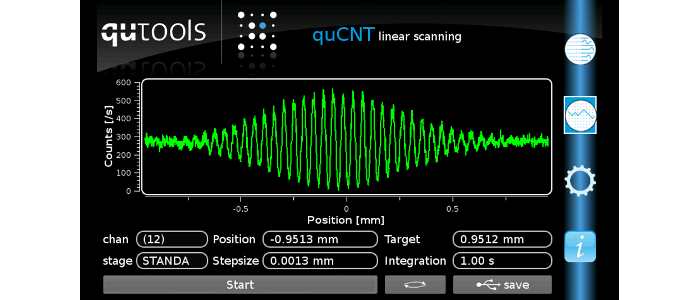
Interference is generally considered to be a wave phenomenon. Curiously it also works with single quantum objects. Use the ED-MI Michelson Interferometer add-on together with the quEDU to show that this is the case. (The photograph shows the motorised version.)
+ ED-HBT Hanbury Brown Twiss
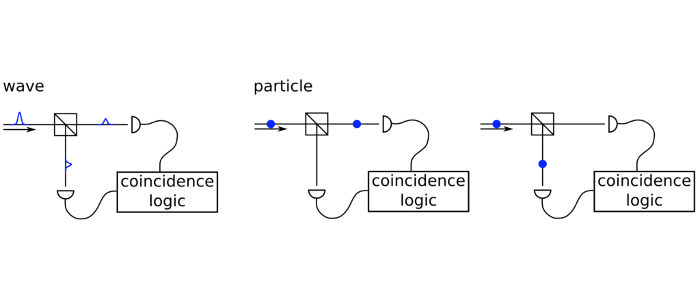
Perform the “Grangier Experiment”, explore the particle nature of single photons with a Hanbury Brown & Twiss setup and build a quantum random bit generator.
Hanbury Brown & Twiss Setup for Heralded Single Photon Sources.
Hanbury Brown-Twiss setup Add-On for the quED
Photons (or generally quantum objects) sometimes also behave like particles. With this add-on you can show that photons can not be split up. You can also explore a simple quantum random bit/number generator and use it in combination with the quED-MI to show wave and particle nature of photons in one experiment.
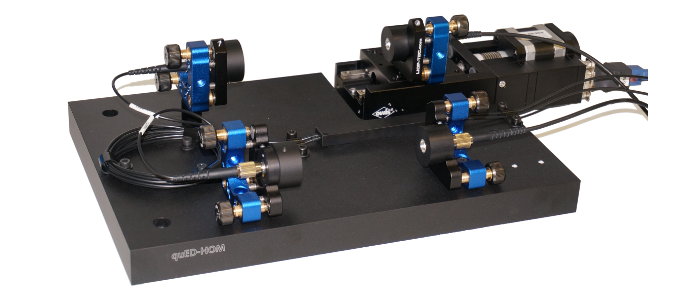
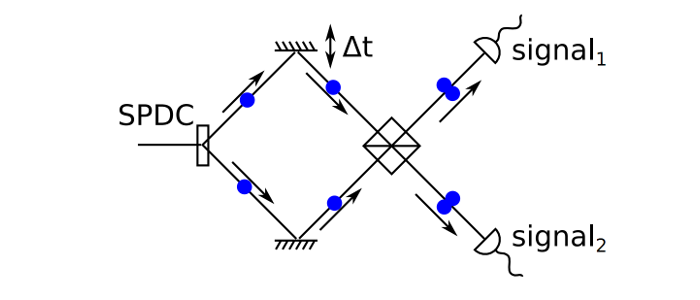
+ ED-HOM Hong–Ou–Mandel Effect
Experience the purely quantum 2-photon interference effect by revealing the Hong-Ou-Mandel dip.
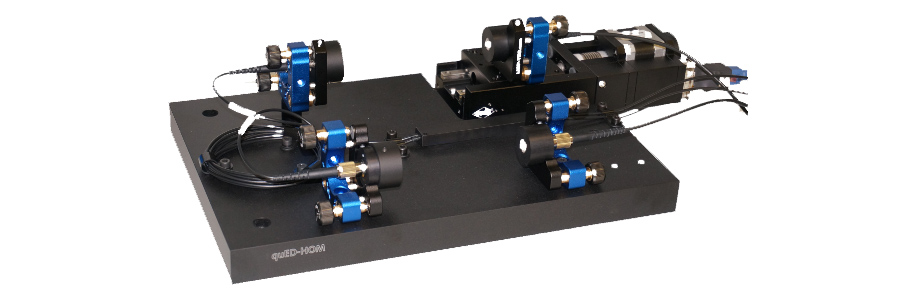
When you have two indistinguishable photons and each of them hit one input of a beam splitter, they exit the beam splitter together in one output port. This is an effect you cannot demonstrate with bright light, but with this add-on you can.
+ ED-QKD Quantum Cryptography
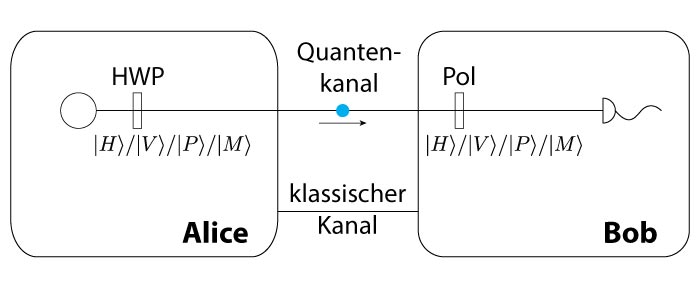
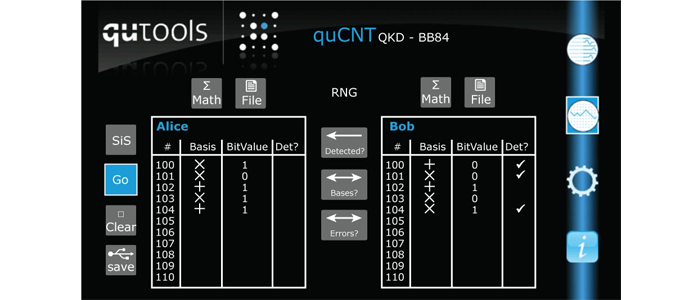
Securely distribute a secret key between Alice and Bob with the BB84 protocol.
Quantum Cryptography Add-On for the ED.
One of the most popular industrial applications for quantum phenomena right now is quantum cryptography, or better, quantum key distribution. With this add-on, you can use weak coherent pulses to simulate realistically how a secure communication between two parties (Alice and Bob) is made possible by the BB84 protocol in a real environment.
+ ED-TOM Quantum State Tomography
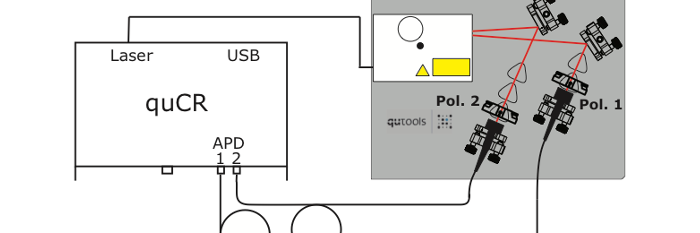
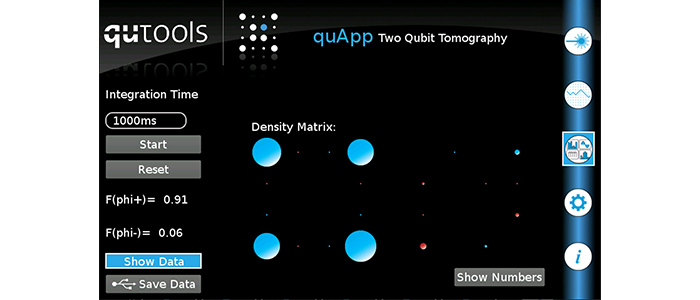
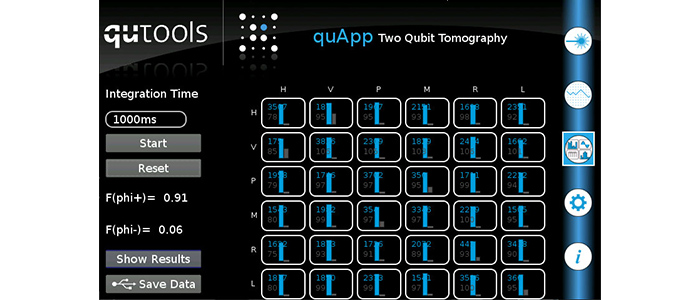
The quED-TOM let you determine the full quantum state density matrix that defines all properties of either a single photonic qubit or even the two-qubit entangled or non-entangled state that can be produced in the quED source.
Quantum State Tomography Setup
Setup of the manual 2-photon tomography with the quED.
Reconstructed density matrix of an entangled |φ +> state.
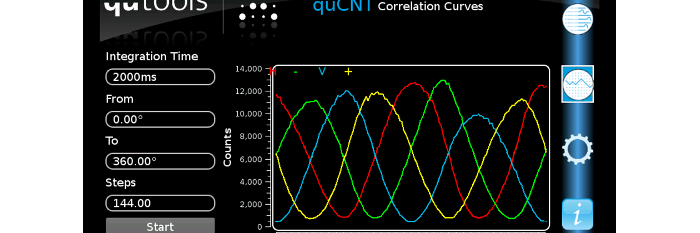
Count rates of all 16 measurements.
A quantum mechanical state can not be determined using only a single measurement. But, if you have an ensemble of equally prepared states, as, e.g., by our SPDC source, there is a procedure that makes the complete determination of the quantum state, i.e. its density matrix, possible.
Sample Experiments
NV Center experiments
NV Center Fluorescence
ODMR
Zeeman Effect
Orientation of NV-Centers in Lattice
Magnetic Field Sensing
ODMR Microscopy
NV Center experiments with Pattern Generator
Spin Initialization and Readout
Rabi Oscillations
Pulse Sequence Development
Coherence Times T2
Ramsey sequence
Dynamical Decoupling, Hahn Echo
Single Photon Experiments without Interference
Particle Nature of Photons
Quantum Cryptography/QKD: BB84 Protocol
Tomographic Single Photon State Reconstruction
Quantum Zeno Effect
Quantum Random Number Generation
Single Photon Experiments with Interference
Wave Nature of Photons: Single Photon Michelson Interferometer
Quantum Eraser
Wave-Particle Dualism: Michelson + HBT
Double Michelson Interferometer
Visible (White) Light Interference (Observable by Eye)
Measurement of the Central Wavelength of Single Photons
Measurement of Coherence Length of Single Photons
Interaction-Free Measurement (Bomb Test)
Photon Pair Experiments with Polarisation Entanglement
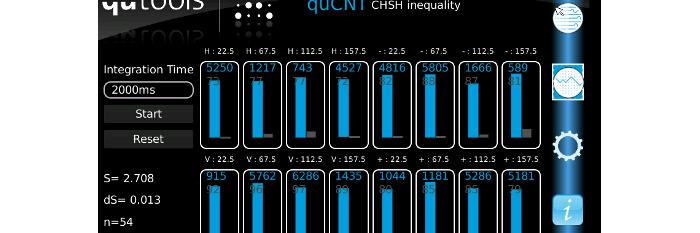
Violation of Bell’s Inequality (CHSH)
“Non-Classical” Polarisation Correlations
Tomographic State Reconstruction of an Entangled Photon State
Quantum Cryptography/QKD: BBM Protocol
Quantum Cryptography: Ekert Protocol
Photon Pair Experiments without Polarisation Entanglement
Hong-Ou-Mandel 2-Photon Interference
Hong-Ou-Mandel Interference + Hanbury Brown & Twiss
We use cookies to ensure that we give you the best experience on our website. If you continue to use this site we will assume that you are happy with it.OkNo

 Interferometers
 Time-Tagger
 Quantum Physics Kits
 quEDU - a Science Kit for Quantum Physics: spin manipulation of NV centers, entangled photon pairs and much more.